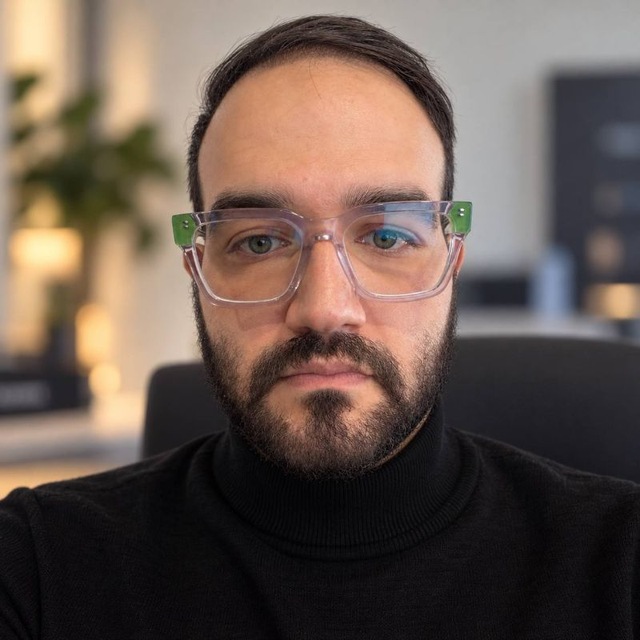
Ali J. Farahani

Head of Product Design

I lead teams from product questions to shipped work.

My work spans crypto trading, payments and e-commerce. I also design AI experiences and build products with AI.

Selected impact

10+

years designing digital products

+30%

KYC: registration conversion in the first week

+18%

Easy Margin: growth in leverage adoption

4–6

designers I usually hired while reshaping a team

More outcomes
+12% / +7%

conversion and retention improvements at Tabdeal

~20%

sales recovered by fixing a travel-booking drop-off

2 each

products across fintech, crypto, and travel

Sources & measurement notes

Impact figures are reported from the original résumé and product work. Where the original reporting window is no longer retained, the site states that limitation rather than reconstructing one.

Decisions you can explore

Professional experience

Head of Product Design

Najmat Alaleab Electronics · IQPayz · Dubai & Iraq · On-site

Mar 2025—Present

Started in March 2025 as a remote project engagement with the independent team and moved into a full-time role after Tabdeal ended in August 2025.

5 contracts, 3,000+ users in month one, +30% onboarding conversion and −30% support load.
Responsibilities & measurement

Leading zero-to-one payments and wallet products while shaping the team operating model: specialist hiring, OKRs, onboarding, 260° reviews, coaching, and cross-squad alignment. Built BigQuery views for daily product-data review and stepped into high-sensitivity work when the risk demanded it.

Head of Product Design

Tabdeal · Crypto Exchange · Tehran · On-site

Aug 2024—Aug 2025

Led product design from August 2024 to August 2025.

+12% funnel conversion, +7% retention, ~23% average registration completion, +9% registration-to-trade conversion, and +18% leverage adoption from internal signal flows.
Responsibilities & measurement

Turned design from a UI-output function into a decision-making team that could bring business problems and solutions forward. In the squad-based model every designer retained end-to-end coverage. Introduced weekly open critique, mandatory 10-minute reviews for urgent handoffs, analytics/A-B/design-system handoff checks, Metabase dashboards, DesignOps templates, tokenized foundations, organization-aligned OKRs, and weekly KPI reporting.

Measurement used defined product events, pre/post funnel analysis, and returning-user cohorts in Metabase; the original reporting windows were not retained.

Head of Product Design

HCT · Travel & Entertainment Products · Tehran & Dubai · On-site

Nov 2022—Aug 2024

Led product design at HCT from November 2022 to August 2024, owning both hands-on product work and team management.

About +20% sales through booking drop-off recovery, estimated against the prior booking baseline; the original reporting window is no longer documented.
Responsibilities & measurement

Evolved the team toward two product-design generalists, a visual designer, and a researcher, adding specialist roles by need. Established normal and urgent review paths, secured need-based training budget tied to knowledge sharing and usefulness review, and used explicit ownership and soft-skill coaching to restore team stability after leadership disruption. HudHud Trip is the public product represented in this portfolio; confidential product lines are intentionally omitted.

Earlier roles (6)

Product Designer

Dabno · Customer Club & E-commerce · Tehran, Iran

Apr 2021—May 2022

UX Designer

Hami Travel · Travel Agency, Immigration · Tehran, Iran

Apr 2020—Jan 2021

Co-Founder (Product Designer & Front-End)

Pingreen · Event Setup Platform · Tehran, Iran

Aug 2016—May 2019

Co-Founder (Product Designer & Front-End)

Givent · Board-Game Community Platform · Tehran, Iran

Aug 2016—May 2019

UI Designer

Ara Co. · Tehran, Iran

Feb 2015—Apr 2016

UX Designer

CaveGate · Tehran, Iran

Jan 2014—Jan 2015

Design should do more than deliver screens

At Tabdeal, I pushed design into the business flows and the data behind them. The team gradually stopped waiting for tasks and started bringing problems and options to the table.

When support became a dependency

I spent two quarters covering the team’s needs and unfinished work. I had helped make that support an expectation.

Read the experience

In my first management role, I spent two quarters trying to meet every team need and covering unfinished work. People began to assume I would finish it. I had helped create that expectation.

Make capacity safe to discuss

Clearer feedback and estimates revealed a capacity problem: people were accepting too much because they feared being blamed.

Read the experience

I introduced clearer feedback and helped the team estimate work. Those conversations exposed another problem: people were accepting too much because they feared being blamed. I made it explicit that a capacity limit was something we would plan around.

Support without taking over

I kept supporting the team while making ownership clearer. Leading the team did not mean finishing every task myself.

Read the experience

I kept helping people through difficulties, while making ownership and expectations clearer. The lesson changed how I lead: taking responsibility for the team does not mean taking every task away from them. I do not have a retained metric for this change.

The team’s operating routines

Build the team around the problem

When the work allowed it, I moved from an all-generalist setup to two generalists, a visual designer, and a researcher. In squad-based teams, I kept broader coverage because specialization would have slowed us down.

Use two review modes, not one

Weekly critiques handled normal work. Urgent handoffs got a ten-minute review so everyone knew what was shipping and could flag a risk before it reached engineering.

A handoff needs evidence

Before handoff, we checked analytics events, A/B-test readiness, success criteria, component reuse, and the implementation context—not just whether the screens looked finished.

Training had to come back to the team

People chose courses against a real need, discussed them with me, and shared what they learned with the team. We also checked later whether the course had actually helped.

Repair the team, not just the plan

After a difficult departure affected the team, I used direct conversations, clearer ownership, and a return to normal product work to rebuild confidence and routine.

Make OKRs visible every week

We connected company goals to the design team’s work and reviewed them weekly alongside funnel conversion, time on task, revision loops, and missed commitments.

In each of my recent companies, I hired four to six people and handled the less visible parts of leading a team too: strategy, OKRs, onboarding, 260° reviews, coaching, and cross-squad alignment.

Where I focus

Product design leadership

  • Product design team leadership
  • Design OKRs & capacity planning
  • Product & engineering alignment
  • Cross-squad design delivery
  • Design prioritization & roadmaps
  • Weekly critique & urgent reviews
  • DesignOps & review documentation

KYC, onboarding & conversion

  • Registration & activation funnels
  • KYC & onboarding design
  • Retention & lifecycle UX
  • Funnel drop-off recovery
  • Complex product journeys

Tokens & component systems

  • Design tokens & semantic theming
  • Component libraries & governance
  • Multi-brand design systems
  • Accessibility-aware UI components
  • Design handoff & UI QA

Product domains

  • Payment gateways & aggregation
  • Crypto trading & leverage UX
  • KYC & account activation
  • Merchant & operations dashboards
  • Travel booking & checkout

Funnel analytics & A/B testing

  • Funnel & design-team KPIs
  • Analytics event definition
  • Metabase funnel analysis
  • A/B test planning

AI product design & development

  • AI product interaction design
  • AI-assisted prototyping
  • AI-assisted product development

Building a complex product? Let’s talk.

I’m looking for a Head or Lead role with an international team, ideally in fintech or another product where the details matter. I’m open to remote, hybrid, or on-site work and need visa sponsorship to relocate.

Location
Dubai
Work model
Remote · hybrid · on-site
Work authorization
Employer visa sponsorship required for relocation
Languages
Persian — Native · English — B2 professional · German — A2, learning